

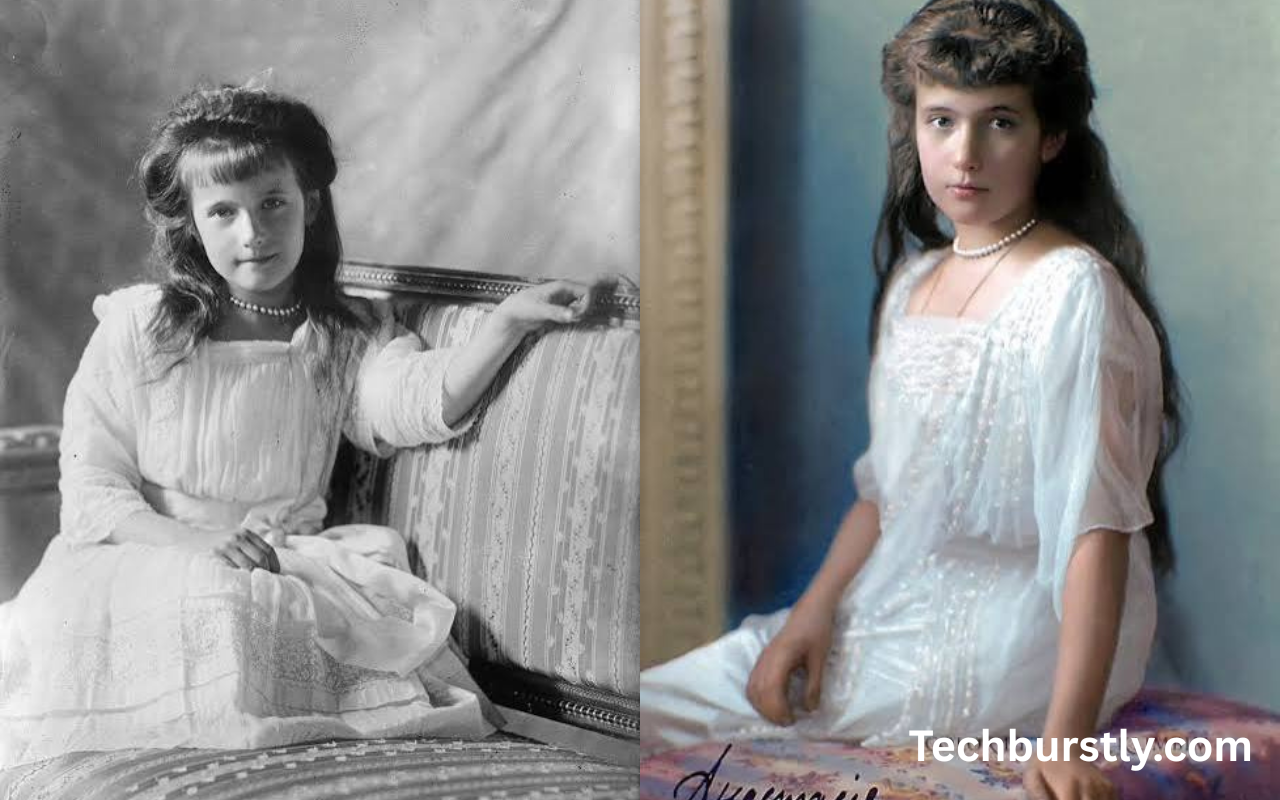
Early Life and Royal Birth
Grand Duchess Anastasia Nikolaevna of Russia was born on June 18, 1901, at Peterhof Palace near Saint Petersburg. She was the youngest daughter of Tsar Nicholas II, the last Emperor of Russia, and Empress Alexandra Feodorovna. As a member of the powerful Romanov dynasty, Anastasia entered a world filled with royal traditions, political influence, and immense privilege. Yet her personal story would become one of the most fascinating and tragic chapters in Russian history.
Table of Contents
ToggleWhen Anastasia was born, many members of the imperial court hoped for a male heir to secure the future of the Romanov throne. Instead, Nicholas and Alexandra welcomed their fourth daughter. Although some aristocrats were disappointed, her parents adored her. A few years later, the birth of her younger brother Alexei finally provided the long-awaited heir to the Russian Empire.
From the beginning, Anastasia displayed a unique personality. Family members often described her as lively, energetic, and full of humor. Unlike the formal image many people associate with royalty, she loved playing games, making jokes, and creating laughter within the palace. These qualities would later make her one of the most beloved members of the Romanov family.
Family Background and the Romanov Dynasty
The Romanov family had ruled Russia for more than three centuries before Anastasia’s birth. Her father, Nicholas II, inherited one of the largest empires in the world, governing millions of people across Europe and Asia. The imperial family lived in magnificent palaces and represented the highest level of Russian society.
Anastasia grew up alongside her three older sisters—Olga, Tatiana, and Maria—and her younger brother Alexei. Together, the sisters were affectionately known as “OTMA,” a nickname created from the first letters of their names. The siblings shared a remarkably close relationship and spent most of their childhood together.
Despite their royal status, the Romanov children were raised with surprising simplicity. Their parents believed that discipline and humility were important values. The children slept on relatively simple beds, performed basic chores, and followed structured daily routines. This upbringing helped shape Anastasia’s character and prevented her from becoming overly spoiled by royal luxury.
Childhood Personality and Character
Among all the Romanov children, Anastasia was known as the family prankster. She possessed a sharp sense of humor and enjoyed teasing relatives, friends, and even palace staff. Her playful nature often brought joy to those around her and helped lighten serious situations.
Historical accounts frequently describe Anastasia as mischievous but lovable. She enjoyed climbing trees, playing outdoor games, and creating practical jokes. While her sisters often appeared more reserved and elegant, Anastasia embraced her energetic personality and rarely worried about maintaining a perfect royal image.
Many people who met her commented on her bright smile and ability to make others laugh. Even as she grew older, she retained much of her youthful spirit. These qualities helped make her one of the most memorable members of the Romanov family and contributed to the fascination surrounding her life after her death.
Education and Daily Life
Like most royal children of the early twentieth century, Anastasia received her education from private tutors rather than attending a public school. She studied subjects such as history, geography, literature, languages, religion, and etiquette. Her education was designed to prepare her for the responsibilities expected of a Russian grand duchess.
Although she was intelligent, Anastasia was not always the most enthusiastic student. She preferred active pursuits and social interactions over long academic lessons. Nevertheless, she developed a strong understanding of Russian culture and European history through her studies.
Photography became one of her favorite hobbies. Many photographs taken by the Romanov family show ordinary moments of family life, providing historians with rare insights into the personalities of Russia’s last imperial family. Through these images, modern audiences can see a more human side of Anastasia and her relatives.
Relationship with Her Parents and Siblings
Anastasia enjoyed a particularly close relationship with her siblings. The Romanov children spent much of their time together and relied on one another for companionship. Their strong family bond became especially important during the difficult years that followed.
Her father, Nicholas II, was known as a devoted parent who frequently spent time with his children. He enjoyed walks, games, and family activities. Anastasia admired her father deeply and remained loyal to him even as political unrest grew throughout Russia.
Her mother, Alexandra, maintained a protective and deeply religious influence within the family. Alexandra’s concern for her son Alexei’s health often dominated family life because he suffered from hemophilia, a serious blood disorder. Despite these challenges, Anastasia remained close to both her parents throughout her life.
World War I and a Changing Russia
The outbreak of World War I in 1914 dramatically changed life for the Romanov family. Russia entered the conflict against Germany and its allies, leading to years of military losses, economic hardship, and growing dissatisfaction among the Russian people.
During the war, Anastasia and her sisters participated in charitable work. They visited wounded soldiers and supported hospital efforts organized by their mother and older sisters. Although still a teenager, Anastasia witnessed the suffering caused by war and gained a deeper understanding of the challenges facing her country.
As the war continued, public confidence in the monarchy weakened. Food shortages, inflation, and political instability increased across Russia. The imperial family became increasingly isolated from ordinary citizens, creating conditions that would eventually lead to revolution.
The Russian Revolution and Loss of Power
By 1917, Russia had reached a breaking point. Mass protests erupted throughout the country, and many soldiers refused to continue supporting the government. Under enormous pressure, Nicholas II abdicated the throne, bringing an end to the Romanov dynasty’s centuries-long rule.
For Anastasia, the change was sudden and devastating. The young grand duchess who had once lived in palaces now found herself living under guard. The family’s freedoms were restricted, and their future became increasingly uncertain.
Despite these hardships, the Romanovs tried to maintain normal family routines. They read books, prayed together, and supported one another emotionally. Anastasia continued to show resilience and optimism even as conditions worsened around her.
Imprisonment and Final Months
Following the revolution, the Romanov family was moved between several locations before eventually being imprisoned in Yekaterinburg. Their living conditions became increasingly restrictive, and communication with the outside world was heavily controlled.
The family remained hopeful that they might eventually be rescued or allowed to leave Russia. Anastasia continued spending time with her siblings and parents, trying to preserve a sense of normality despite the uncertainty surrounding them.
However, political tensions and the ongoing Russian Civil War created a dangerous environment. Bolshevik leaders feared that advancing anti-Bolshevik forces might free the Romanovs, leading to decisions that would forever alter history.
Death and the Romanov Execution
During the night of July 16–17, 1918, Anastasia and her family were awakened and told they were being moved for safety reasons. Instead, they were taken to a basement room in the Ipatiev House in Yekaterinburg.
There, Bolshevik executioners carried out the murder of Nicholas II, Alexandra, their five children, and several loyal servants. Anastasia was only seventeen years old when her life came to an end. The execution marked one of the most significant and tragic events of the Russian Revolution.
For years afterward, uncertainty about the location of the bodies fueled speculation and rumors. Because evidence was limited, many people questioned whether all members of the family had truly died that night.
The Famous Anastasia Survival Mystery
No aspect of Anastasia’s story became more famous than the mystery surrounding her fate. Throughout the twentieth century, numerous women claimed to be the surviving grand duchess. These claims attracted enormous public attention and transformed Anastasia into a global legend.
The most famous claimant was Anna Anderson, who spent decades insisting she was Anastasia. Her story inspired books, films, and endless debates among historians, journalists, and members of the public.
Modern DNA testing eventually solved the mystery. Scientific analysis confirmed that Anastasia died with her family in 1918 and that none of the claimants were related to the Romanovs. While the mystery has been resolved, fascination with Anastasia’s story continues to this day.
Legacy, Cultural Impact, and Historical Importance
More than a century after her death, Anastasia remains one of the most recognizable royal figures in modern history. Her story symbolizes both the fall of Imperial Russia and the human cost of political revolution.
Books, documentaries, television programs, stage productions, and films have kept her memory alive. The popular animated movie Anastasia introduced millions of people worldwide to a fictionalized version of her story, ensuring that new generations continue to learn about her life.
In 2000, Anastasia and her family were canonized by the Russian Orthodox Church as Passion Bearers. This recognition reinforced their significance within Russian history and religious tradition. Today, historians continue studying the Romanov family, using letters, photographs, and archival records to better understand their lives and legacy.
Conclusion
Grand Duchess Anastasia Nikolaevna of Russia lived for only seventeen years, yet her influence has lasted for more than a century. Born into extraordinary privilege, she experienced the dramatic collapse of an empire, endured imprisonment, and became one of history’s most famous royal figures. Her cheerful personality, close family bonds, and tragic fate continue to captivate readers around the world.
Beyond the myths and legends, Anastasia was a real young woman whose life was shaped by events far beyond her control. Through surviving photographs, letters, and historical records, we see a spirited teenager who loved her family, enjoyed laughter, and faced uncertainty with courage.
As Grand Duchess Anastasia Nikolaevna of Russia continues to inspire historians, writers, and readers, her story serves as a powerful reminder that history is ultimately about people. Her legacy stands as a testament to resilience, family devotion, and the enduring impact one life can have on generations that follow.
